

It’s an evening in front of the tv, your partner is watching another basketball game. Time to break open the computer and do some research. Do you just wing it? Google the question and see what’s out there? Or take the time to create a research log for that burning question? Even if the question seems simple you may find yourself going down the rabbit hole, what seemed simple can turn into many open browser tabs and lost information days later.
While it seems like a lot of work, my methodology in my research starts first with a research log. And trust me there have been many times I haven’t taken my own advice. It never ended well.
A research log can:
Keep you organized – You are better able to pick up where you left off.
Save you from looking at sources already viewed making your research more efficient.
Help in evaluating sources and conflicting information – Useful for refining where to research.
Reveal patterns of information and aid in developing theories that can change along the way.
Whether you’re researching the process of making bricks in 1834 or chasing down an elusive ancestor, a research log can keep you focused and moving steadily toward the next step in developing historical accuracy for the time period your character lived.
When I was exploring my family’s occupations in Washington D.C., I discovered a ship list denoting the father’s occupation as a “mason.” Once the family arrived in the district, they needed work, and I wanted to bring to life the day-to-day labor of a mason. It’s hard, dirty, hot work.
I knew nothing about making bricks and found myself asking: Where did the clay come from? How was it mixed? How were the molds made? What was the next step in the process? Where were the bricks baked and how many at a time? How were the kilns arranged to heat evenly, or did they heat evenly. Each of these questions added depth to my story.
While it may feel like an extra step keeping a research log will save you hours in the long run. It allows you to retrace your steps, avoid repeating searched and build a clear path from your first question to your last discovery.
Here’s an example of a Research Log -
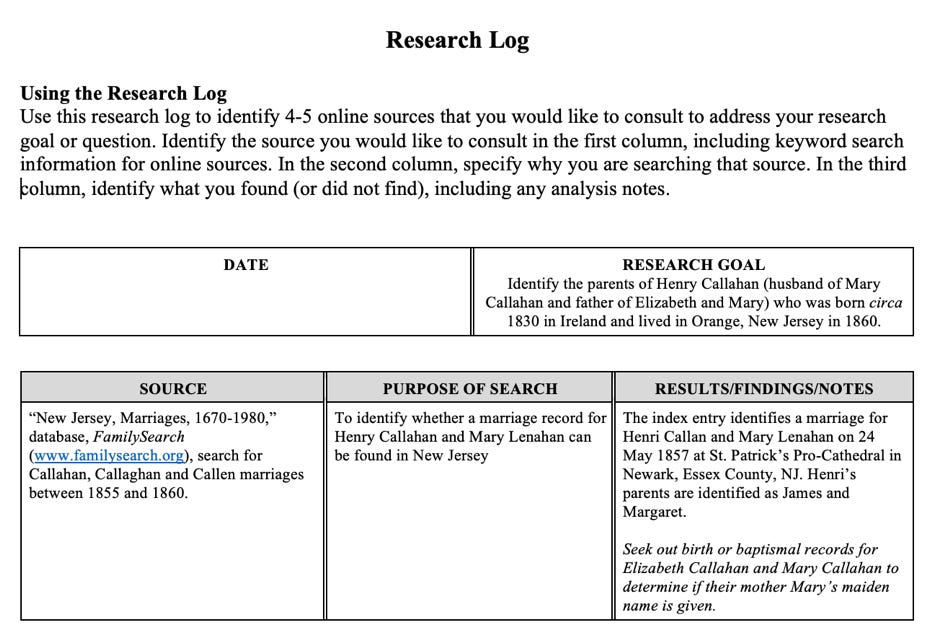
You can Find other examples and free templates online such as at The Family Locket.
What are you currently researching?
Cover image - Image shows a black-and-white engraving published in 1834 to portray Washington, D.C. and the west front of the U.S. Capitol grounds as they were in 1800. Includes the west end of the west grounds and Pennsylvania Avenue, with poplar trees planted in 1803.
At this very moment I have 14 tabs open and a string of research on ChatGPT, because I can't stop following the rabbit. AND I'm the type of person who can't stand an unread email or a messy browser. Each tab has a tiny tidbit of info that I think I need. Mining that data will be an afternoon's worth of work. I suppose a research log would keep me organized just in case the browser crashes. Thanks for the tip, Lisa!
.....this is truly life changing. you mean i don't need to keep 1820206 tabs on joan of arc up until i finish my essay?!?!??